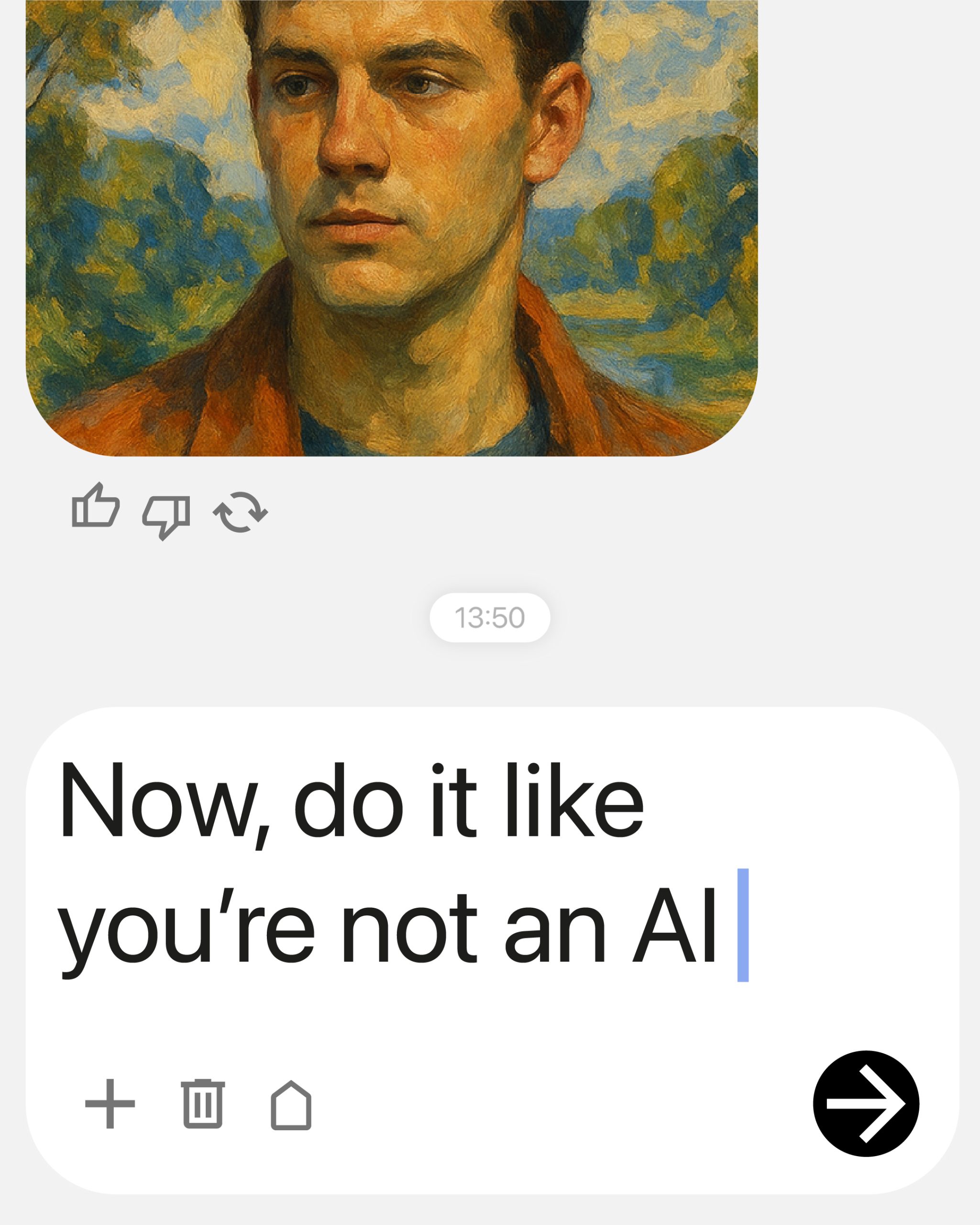
If AI can create everything, what’s left?

Branding proves that the future is human.

Calling Artificial Intelligence one of the great revolutions of the century won’t surprise anyone. Its impact—past, present, and future—is undeniable. The creative and consulting industries seem seriously threatened. At least, at first glance.

AI can, among other things, automate creative processes: write texts, generate images, compose music, and even design strategies. This ability has led many outsiders to believe that a single prompt is enough to have an agency in their pocket. At Knom, we’re here to refute that idea.

As obvious as it may sound, a tool is not the same as a discipline. A tool executes, automates, accelerates, and facilitates. A discipline like branding connects values, culture, emotions, and narratives with the business of companies and the people they engage with. Just as owning brushes doesn’t make one a painter, having access to AI doesn’t make one a brand strategist.

Branding deals with identity, culture, purpose, collective imagination, values, and expectations—concepts that demand deeply human interpretation. One where reason alone isn’t enough, because emotion, symbolism, and intuition come into play. It’s precisely in that space—the subjective—where the true value of humanity lies, and where AI cannot reach.

How many brands have failed because they misread the social context? It’s impossible to connect with users without feeling. And that might be the key: feeling the same reality as our clients’ audiences—knowing firsthand the frustration of a call center, the pleasure of drinking your favorite coffee, or the attachment to an app that has become essential.
After all, can any AI truly understand what it feels like to drive a high-end car? BMW just lost its slogan.

AI will undoubtedly impact the industry, but at Knom we choose to focus on the opportunity it brings. From process acceleration and testing to moodboards and inspiration searches, AI speeds things up—but still needs human direction. It’s a tool, not a substitute. The winners of this race will be those who know how to harness it without falling for its siren song of shortcuts that save time but drain meaning and feeling.

AI amplifies the capabilities of those who already have expertise; it doesn’t create new ones out of ignorance. We’re already beginning to see the diminishing returns that follow every revolutionary innovation—and one of AI’s boundaries lies precisely here.

In a world where brands are becoming increasingly homogenized, branding gains critical importance—as both a compass and a differentiator. In a landscape flooded with infinite AI-generated outputs, the brands made by people will be the ones that stand out.

We’re facing a unique moment—one where being human becomes the ultimate differentiator and the reason worth celebrating together.
Verbal engineering to connect with your audience

Today we’re here to talk about one of the most powerful (and yet most underrated) tools in branding: tone of voice.

Tone of voice is a fundamental tool that helps us shape and express our brand’s personality. But it’s also a highly strategic part of branding that, if done well, can achieve the following:

  • Greater brand recognition: a consistent tone is more memorable and helps people identify your brand even without seeing your logo.
  • People connecting with your brand: speaking in your audience’s language helps you empathize and humanize your brand.
  • Truly standing out: when everyone communicates in the same way, how you speak is what sets you apart from the rest.
  • Your strategy to be grounded: tone of voice activates your brand, turning the abstract concepts of your brand platform into tangible messages.

How do you create a good tone of voice?

As with people, the starting point for achieving a consistent tone of voice is to be clear about our personality. From there, we will follow three steps:

  1. Analyze the market
    Before defining our tone, we need to see how others speak. Therefore, we will begin by studying our competitors’ discourse to identify gaps and opportunities.
  2. Define the verbal label
    Once we have identified our competitors and defined our brand personality, we will create the verbal label. In other words, the golden rule that any brand message we launch must comply with.
  3. Develop a series of linguistic resources
    Now, at this point, our tone becomes tangible. We will define three types of resources: differential or impact resources, style resources, and key concepts. (We will explore these in more detail below.)

The tone of voice from a real case study: KeepCoding

KeepCoding is a high-performance training center for programming and technology with a unique humanistic approach. When it came to us in 2024, KeepCoding needed to evolve its brand in a way that would allow it to expand its training portfolio and also consolidate its positioning, strengths, and unique value proposition in terms of communication.

Our strategic analysis led us to the concept of “Human-powered Future”, where the school’s humanistic methodology became a central asset of the brand.

In addition to this strategic territory, we defined four main personality attributes and articulated the brand around two archetypes from Carl Jung’s wheel: the hero and the creator. This combination allowed us to emphasize values such as the hero’s determination, high standards, and commitment, but also the creator’s innovation, nonconformity, genuine character, and vision.

With the personality defined, we moved on to the tone of voice. The first step, as you know, was to come up with our verbal tagline: “Creating the future.” So, after writing any content for KeepCoding, we must ask ourselves if that message contributes to creating the future.

The combination of our personality and verbal tagline results in a motivating tone of voice that inspires and empowers. It speaks from reason, but convinces through emotion, desire, and motivation, opening our eyes to a new perspective on the future.

To ensure that this tone of voice was consistent and memorable, we developed the following types of linguistic resources:

Impactful resources: these are unique structures or formulas that generate immediate recognition. Given that one of the objectives of the brand strategy was to broaden the meaning of the ‘coding’ in our naming, we built a message structure that worked in this direction:

  • Learn skills that make us more efficient. KeepEvolving
  • Analyze feedback to keep improving. KeepImproving
  • Develop an app that helps reduce energy consumption. KeepInspiring

Style resources: these are guidelines that guide how we express ourselves (vocabulary, type of verbs, use of grammatical persons, linguistic licenses, etc.). The world of technology, marketing, and training is an Anglo-Saxon world. That’s why, for KeepCoding, we decided that messages could mix languages without fear.

Key concepts: these are ideas that we will introduce into our discourse so that, through repetition, the market will associate our brand with them. For example, humanity was an essential concept of the KeepCoding brand.

As you can see, tone of voice is a key tool for activating a brand’s personality. It is what turns a brand into a conversation, a discourse into an attitude, and an audience into a community.

If you feel that your brand speaks… but does not resonate, perhaps it is time to apply a little verbal engineering.